Hubert Twitchell
The Door into SummerHubert Twitchell is a gifted physicist whose temporal-displacement experiment changes the course of Dan Davis’s life: after years of obscurity and disappointment, Twitchell activates his apparatus and sends Dan back to 1970. His story joins scientific achievement to wounded pride, showing how a consequential discovery can remain inaccessible until a volatile encounter forces it into action.
Identity and Background
Twitchell is introduced through Chuck Freudenberg’s account of working as a student laboratory assistant at the University of Colorado Boulder. During Chuck’s senior year, he was reassigned from a cryogenics laboratory to a new physics laboratory in the mountains, built for a defense contract involving Edinburgh field theory. There he worked under Dr. Hubert Twitchell, a physicist who had narrowly missed the Nobel Prize and had become bitter about the loss.
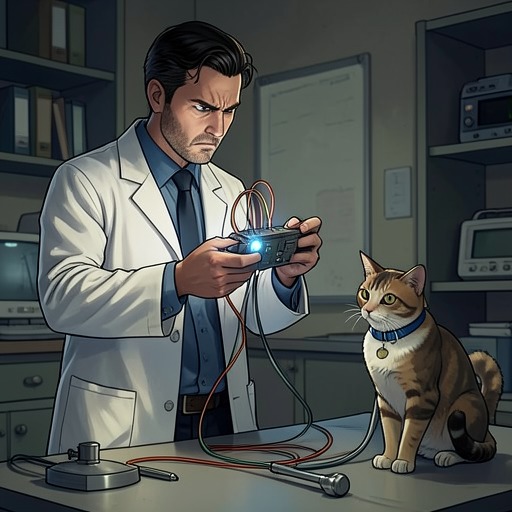
Twitchell’s earlier research also involved an experiment in gravitation. Chuck recalls that Twitchell wondered whether polarizing around another axis could reverse the gravitational field rather than merely level it. When the initial attempt produced no visible result, Twitchell entered the results into a computer and became excited by what it returned. He then placed two marked silver dollars in a test cage and operated a solenoid; both coins disappeared. One reappeared a week later. Before that return, a guinea pig appeared in the cage, though it did not belong to the laboratory. Chuck took it home after checking with the biology laboratory, which had not noticed any missing animals.
The Time Laboratory and the Demonstration
By the time Dan meets him, Twitchell has retired from active work and holds emeritus status. He spends much of his waking time drinking at the faculty club, which is closed to outsiders. Dan takes four days to find him in another bar, where buying him a drink opens a conversation. Dan sees a once-magnificent intellect diminished by age, alcohol, and disappointment, but still formidable. Twitchell agrees to consider Dan’s proposal to write about his life and work; by the next day, he assumes Dan intends to write a whole book, and talks at length while Dan takes genuine notes.
Dan eventually raises the story of the colonel whose actions had, he suggests, cost Twitchell the Nobel Prize. Twitchell responds with several minutes of furious cursing and demands to know who told Dan. The exchange exposes the old injury behind his resentment, while also giving Dan a way to establish that he has access to information from his work for the Department of Defense. Twitchell does not immediately show him the laboratory: a week passes before he agrees.
Twitchell has retained his time laboratory even after most of the building was taken over by other researchers. He invokes the room’s classified status to prevent anyone else from using it or dismantling its apparatus. Inside, he lectures Dan on the mathematics of time theory and temporal displacement, warning him not to take notes. When Dan suggests that Twitchell had never been able to calibrate the apparatus—to measure the exact magnitude of its displacement—Twitchell angrily rejects the claim and insists that measurement is essential to science. He turns to the controls to demonstrate.
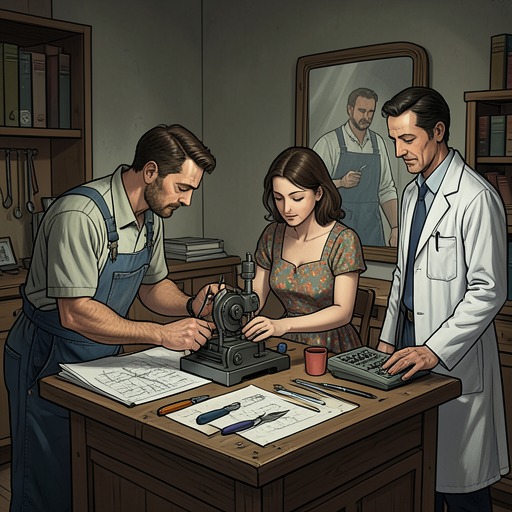
The visible apparatus includes a low platform enclosed by a cage, which Twitchell calls the temporal locus stage, and a control board. Dan recognizes components such as an eight-point Brown recorder and heavy solenoid-actuated switches, but lacks the circuit diagrams needed to understand the system. Twitchell asks whether Dan has any change in his pocket, then calls the university powerhouse to demand emergency full power for the Thornton Memorial Laboratory. He orders power across the bus bars in exactly eight minutes, waits for the meters to swing and the red indicator to light, and announces that the power is ready.
Dan’s Return to 1970
Dan’s confrontation with Twitchell turns the demonstration into the decisive event of the character’s plot. Dan challenges him to press the button, taunting him that it is a hoax and invoking the colonel who had supposedly dismissed him. Twitchell finally acts. Dan tries to stop him, but the apparatus is already carrying Dan away. In the instant before the displacement takes effect, Dan regrets having goaded an old man who had done him no harm and recognizes that he does not know where he is going or whether he can get there.
The experiment sends Dan to 1970. Its effect makes Twitchell more than a disgruntled scientist recalled in another man’s story: the preserved apparatus and his decision to activate it directly enable Dan’s return to the past. The machine’s operation is not presented as a calm, planned service. It happens because scientific pride, Dan’s calculated provocation, and Twitchell’s long-standing resentment converge in the laboratory.
Relationships, Legacy, and Narrative Role
Dan’s relationship with Twitchell begins as research for a biography but becomes an obligation. Dan seeks Twitchell out partly because he knows the physicist’s history and wants him to speak about it; the biography gives Twitchell a listener, while Dan’s questions reopen the humiliation of his lost Nobel opportunity. Their meeting is therefore both an attempt to record an overlooked career and a personal confrontation with the injury that has shaped Twitchell’s later life.
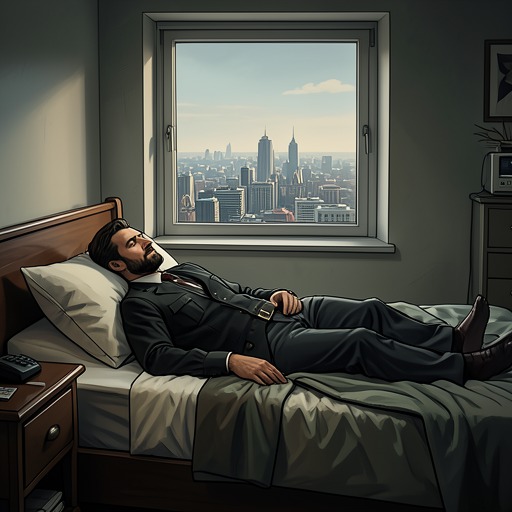
After returning through cold sleep, Dan writes to Twitchell, explains that he has made the journey, and apologizes abjectly for having doubted him. He asks whether Twitchell wants to see the manuscript when it is finished, but receives no answer and assumes Twitchell remains angry. Dan nonetheless commits to writing the book, titled Unsung Genius, and placing it in major libraries even if he must publish it at his own expense. He explicitly says he owes Twitchell for what happened to him, and for Pete and Ricky as well. That later acknowledgment recasts the earlier laboratory scene: the taunt that made the experiment happen was followed by a debt Dan believes he must repay through public recognition.
Twitchell’s narrative significance lies in the gap between the scale of his intellect and the narrow, embittered life in which Dan finds him. The time laboratory has survived even when Twitchell’s professional standing and confidence have not; its classified status preserves the machine, while his resentment keeps the past injury alive. His act of turning it on changes Dan’s future, and Dan’s proposed biography becomes an effort to keep the scientist’s work from disappearing into obscurity. The guinea pig that appears in Chuck’s account also links Twitchell’s earlier experiments to Dan’s later explanation of temporal self-consistency: Dan uses a hypothetical guinea pig sent back a week to explain how an animal could already have been found before it was placed in the cage. The detail gives the laboratory’s strange history a continuing place in the novel’s account of time.